

Choosing the wrong transcription style for your research wastes time, creates unreliable data, or exposes you to legal risk. A legal team using clean read for a deposition loses evidence. A qualitative researcher using full verbatim for thematic analysis spends hours cutting through meaningless filler. A researcher who switches styles mid-project can't compare data across interviews. This guide cuts through the confusion about verbatim vs intelligent verbatim vs clean read—the three main transcription styles used in research, legal work, and business. It shows exactly when to use each style with real examples, decision frameworks, and implementation steps.
When you're doing research interview transcription or managing qualitative research interviews, understanding these transcription methods matters. Whether you need full verbatim transcription for legal depositions, intelligent verbatim transcription for academic analysis, or clean read transcription for publishing, choosing the right format affects your findings. This transcription style guide explains the differences, shows you how to choose transcription style, and gives you a decision framework for matching the right format to your actual research needs.
The best transcription format for interviews depends entirely on how you'll use the data. Transcription for legal proceedings demands one approach. Transcription style for qualitative research demands another. Qualitative research transcription methods vary based on your analysis approach. And transcription accuracy for research depends partly on which style you select. Your choice shapes what you can learn from your data. Spend five minutes now choosing the right one. It saves ten hours of rework later.
Part 1: Full Verbatim—Captures Everything
What Is Full Verbatim Transcription?
Full verbatim transcription captures every word, sound, and pause exactly as spoken. Nothing is removed or cleaned up. When you request full verbatim, the transcriber includes every "um," "uh," stutter, false start, repeated word, long pause, background noise, and non-verbal sound. The result is dense, reads like natural speech, and preserves every detail.
What gets included: filler words (um, uh, ah), false starts and self-corrections, stutters and repetitions, marked pauses ([pause], [long pause]), throat clearing and coughing, laughter and sighs, background noises, every incomplete sentence as spoken.
What does NOT get included: interpretation, cleanup, guessing about unclear words, grammar correction, or assumptions about speaker intent.
Example: Full Verbatim in Practice
Here is a short transcript sample in full verbatim format to show exactly what you get:
Interviewer: So can you tell me about your experience with, um, with the project?
Participant: Yeah, so, uh, we—we started, um, last year and, uh... [pause] ...it was, you know, really challenging at first. We had some, some setbacks.
Interviewer: What kind of setbacks?
Participant: Well, um, the timeline got, got pushed back, um, three months because, uh, we couldn't get the resources we needed. It was, um, [pause] ...it was difficult, you know?
Notice every filler word is there. Every repetition stays. Pauses are marked. Nothing has been smoothed or cleaned.
Why Researchers Use Full Verbatim
Transcription for legal proceedings requires full verbatim as the standard. Every word matters for the legal record. A hesitation before answering a key question can influence how testimony is interpreted. Speech patterns, pauses, and even uncertainty markers carry evidentiary weight.
Linguistic analysis demands full verbatim transcription. Studying how people speak (not what they say) requires capturing every detail. Researchers analyzing dialect, grammar patterns, or speech disorders need the exact utterances as spoken.
Discourse and conversational analysis: Understanding how people interact—turn-taking, interruptions, emphasis—requires precise notation of pauses, overlaps, and speech timing.
Speech pathology and language assessment: Evaluating speech disorders, language development, or communication disorders demands capturing exact speech patterns including stutters and hesitations.
Research where hesitations reveal thinking: In some research, the pause or "um" tells you something important. A researcher studying decision-making might find that longer pauses before answers indicate deliberation. That detail gets lost in cleaner versions.
Compliance with legal discovery rules: Some courts and legal jurisdictions require full verbatim transcripts. Using anything less creates legal exposure.
Real Use Case: Why This Matters
A lawyer preparing for cross-examination of a witness at trial notices in the full verbatim transcript that the witness paused for three seconds before answering whether she saw the defendant at the scene. The transcriber marked this pause because full verbatim includes it. The pause—combined with the witness's later admission that she wasn't wearing her glasses—suggests the witness may be uncertain or reconstructing memory rather than recalling a clear image. That three-second pause becomes part of the cross-examination strategy. Without full verbatim transcription, that detail disappears.
Accuracy and Cost Trade-offs
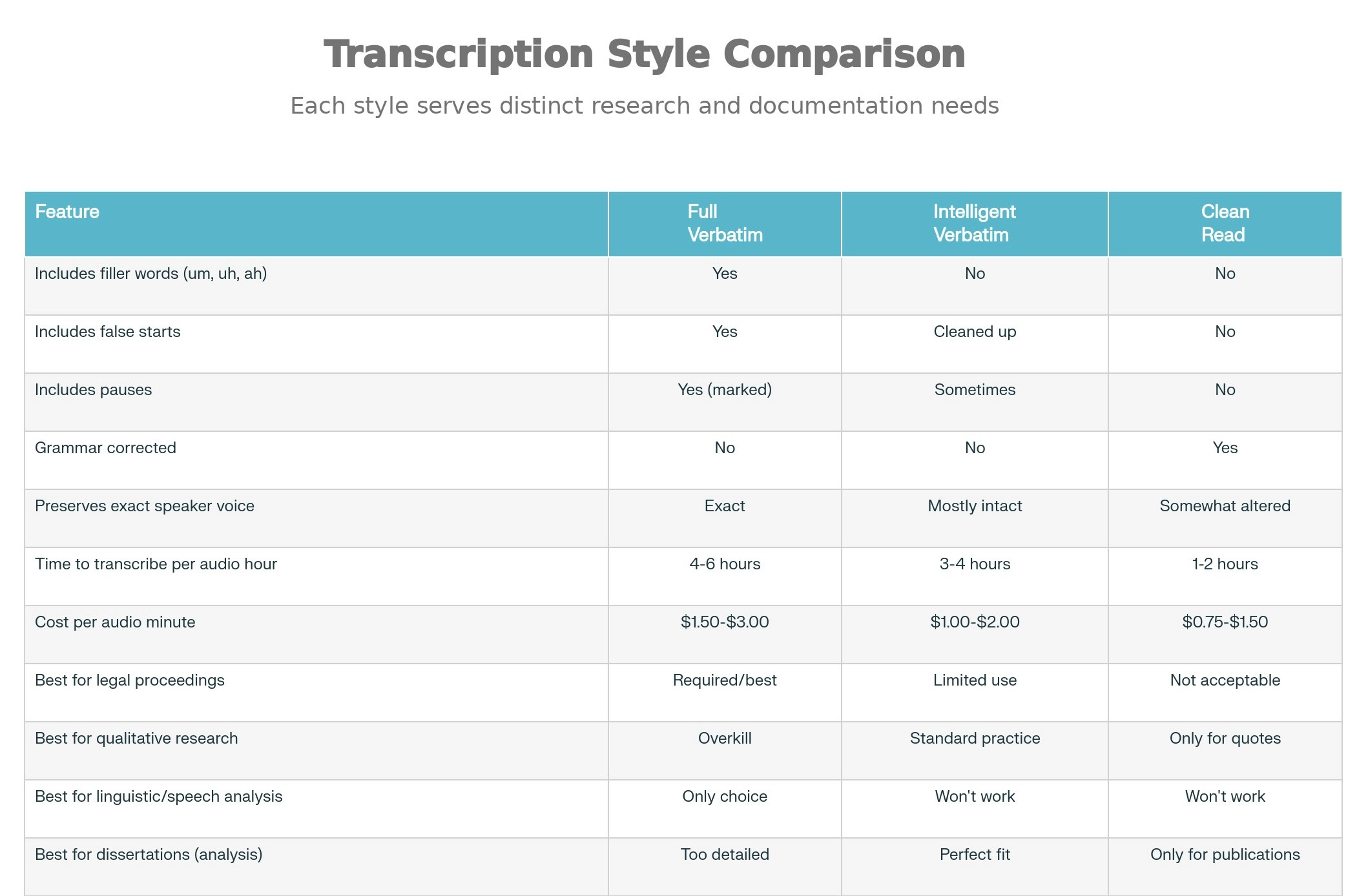
Transcription accuracy for research is highest with full verbatim, but it takes longest. Capturing every detail requires attention to subtle speech patterns. Transcribers must distinguish between "um," "uh," and "er." They must time pauses. They must mark non-verbal sounds. For a typical hour of audio with one speaker, expect 4–6 hours of transcription time. With multiple speakers or unclear audio, it takes longer.
Cost runs highest for full verbatim—typically $1.50–$3.00 per audio minute for human transcription, compared to $1.00–$2.00 for intelligent verbatim and $0.75–$1.50 for clean read.
The trade-off: You get absolute detail, but you also get a dense, harder-to-read transcript. For research where you don't actually need those details, full verbatim creates work during analysis.
Part 2: Intelligent Verbatim—Clean Up Fillers, Keep Meaning
What Is Intelligent Verbatim Transcription?
Intelligent verbatim transcription (also called clean verbatim or smart verbatim) removes filler words and false starts while keeping the speaker's actual message and tone intact. The transcriber cleans up speech to make it more readable, but preserves authenticity. It reads more smoothly than full verbatim but keeps the speaker's real voice.
What gets removed: "um," "uh," "ah," "you know," "like," "basically," repeated words, false starts, stutters that don't affect meaning.
What stays: Everything that carries meaning, the speaker's grammar as spoken (including errors), tone and voice, important pauses that affect meaning, the speaker's real words without rewriting.
Example: Intelligent Verbatim in Practice
Here is the same transcript sample in intelligent verbatim format:
Interviewer: Can you tell me about your experience with the project?
Participant: We started last year and it was really challenging at first. We had some setbacks.
Interviewer: What kind of setbacks?
Participant: The timeline got pushed back three months because we couldn't get the resources we needed. It was difficult.
Compare this to the full verbatim version. The meaning is identical. The fillers are gone. The false starts ("we—we started") are cleaned to "we started." Repetitions ("some, some setbacks") become "some setbacks." But the speaker's core message remains exactly as they said it. You lost the "um"s but kept the authenticity.
Why Researchers Use Intelligent Verbatim
Qualitative research interviews make up the most common use case for intelligent verbatim. This is the standard transcription style for qualitative research. Researchers doing interviews to understand experiences, beliefs, or themes don't need fillers. The content matters. The speaker's voice matters. Fillers get in the way of analysis.
Thematic analysis and coding: When you're breaking transcripts into codes and themes, filler words clutter the process. Intelligent verbatim lets you focus on meaning.
Dissertation and thesis work: Most universities assume intelligent verbatim unless told otherwise. It's the standard for qualitative dissertations and research interview transcription.
Focus group discussions: For market research or program evaluation, you want to understand what people think, not count their "um"s. Intelligent verbatim captures group dynamics and content without the noise.
Evaluation research and program assessments: Evaluators analyzing how programs work and what participants experience use intelligent verbatim for clarity and speed.
Publishing research findings: When you analyze with intelligent verbatim and then pull quotations for your paper, the quotations read more naturally. Readers see the speaker's voice without speech tics.
Real Use Case: Why This Works
A PhD researcher conducting 20 interviews about workplace culture doesn't need every "um" to understand whether employees feel valued and included. Reading the full verbatim version wastes their time during coding. They code for themes like "belonging," "respect," and "contribution." Intelligent verbatim gives them the meaning without the speech noise. Analysis runs faster. They can focus on what actually matters to their research question. This is why qualitative research transcription methods most commonly rely on intelligent verbatim rather than full verbatim.
The Time and Cost Trade-off
Intelligent verbatim takes less time than full verbatim but more than clean read. The transcriber has to make judgment calls about what counts as "filler" versus "meaningful." For a typical hour of audio, expect 3–4 hours of transcription time.
Cost lands in the middle: $1.00–$2.00 per audio minute for human transcription.
Important limit: Don't use intelligent verbatim if exact wording matters. If you're analyzing grammar or studying how people phrase things, you need full verbatim. If you're studying meaning, intelligent verbatim works perfectly.
Part 3: Clean Read—Polished for Publication
What Is Clean Read Transcription?
Clean read transcription (also called edited transcription or non-verbatim) creates a polished, professionally written version of the audio. The transcriber removes fillers, fixes grammar, rewrites awkward sentences for clarity, removes pauses, and produces text that reads like it was written, not spoken.
What gets removed: all filler words, false starts, stutters, repetitions, speech patterns, pauses, non-verbal sounds.
What gets changed: grammar is corrected to standard English, broken or run-on sentences are rewritten for clarity, rambling is condensed, meaning is rephrased to be more direct.
Result: Text that reads professionally. Readers understand the core idea quickly. The transcript looks like written prose.
Example: Clean Read in Practice
Here is the same transcript sample in clean read format:
Interviewer: What was your experience with the project?
Participant: We started the project last year and encountered significant early challenges. The primary issue was a three-month timeline delay caused by insufficient resources.
Interviewer: How did those resource constraints affect your work?
Participant: The resource limitations made it difficult to meet our initial objectives.
The version reads smoothly. Sentences are complete. Grammar is correct. But it reads less like a real conversation and more like a written report. The speaker's casual tone ("it was difficult") becomes formal ("resource constraints"). This version is publication-ready but loses the raw authenticity of how the person actually spoke.
Why Researchers Use Clean Read
Publishing interview quotes in articles or books is where clean read transcription shines. When you want to include quotations in a published paper, clean read versions read better. Readers don't need to see every "um." The quote conveys the speaker's point clearly. This is the best transcription format for interviews when the goal is publication rather than analysis.
Training materials from interviews: If you're creating training content based on interviews, clean read gives you polished, professional text.
Executive summaries and policy briefs: Leaders and policymakers prefer clear, concise writing. Clean read serves this purpose.
Communications where readability matters most: Marketing content, internal memos, and public-facing materials use clean read when the goal is easy reading over authenticity.
Broadcasting and media: Radio scripts, podcast transcripts, and video captions often use clean read or something close to it for smooth reading.
Real Use Case: Why This Makes Sense
A researcher publishes findings from 30 interviews in a journal. The analysis was done with intelligent verbatim transcripts, so they understood the themes accurately. Now they're writing the article and wants to include quotations that show their findings. Pulling clean read versions of key quotes makes them publication-ready and helps the journal's readers understand the core findings without distraction. The researcher's integrity is intact because the analysis came from intelligent verbatim data. The clean read versions are just for presentation.
Important Trade-off: What You Lose
Clean read sacrifices authenticity for readability. The transcriber's interpretation shapes the final version. If the transcriber misunderstands a phrase or rewrites something poorly, the meaning can shift.
Time is fastest: 1–2 hours per audio hour.
Cost is lowest: $0.75–$1.50 per audio minute.
But use clean read only after analysis is complete. Never analyze with clean read transcripts. You'll lose the exact words and create data integrity problems.
Part 4: Side-by-Side Comparison
See the comparison table included separately for a quick visual reference showing how the three styles differ across key dimensions like cost, time, best use cases, and what gets included or removed in each format.
Part 5: Matching Style to Your Research Goals
Decision Framework: Key Questions to Ask First
Before you transcribe, answer these questions:
What will you use this transcript for? Analysis? Publication? Legal record? Evidence in a case?
Do you need to study HOW people speak or WHAT they say? HOW → full verbatim. WHAT → intelligent verbatim. POLISHED VERSION → clean read.
Will others rely on exact wording? Legal teams do. Marketing teams looking for quotes do. Yes → full verbatim or intelligent verbatim. No → clean read is fine.
Are there legal or compliance requirements? Court depositions have no choice: full verbatim. Legal discovery often requires full verbatim. Check first.
Does your funder or institution specify? Check your IRB approval, grant requirements, or department standards. Many universities specify intelligent verbatim for dissertations.
Decision Framework by Research Type
Legal and Compliance Research:
Court depositions → Full Verbatim (non-negotiable)
Transcription for legal proceedings → Full Verbatim
Legal discovery → Full Verbatim (compliance requirement)
Witness statements → Full Verbatim
Regulatory interviews → Full Verbatim
Workplace investigations → Full or Intelligent (depends on what you're proving)
Academic and Qualitative Research:
Dissertation interviews → Intelligent Verbatim (standard in most fields)
Research interview transcription → Intelligent Verbatim (standard practice)
Qualitative research interviews → Intelligent Verbatim
Focus groups for market research → Intelligent Verbatim
Case studies → Intelligent Verbatim (for analysis), then Clean Read (for publications)
Phenomenological research → Intelligent Verbatim (preserves voice and meaning)
Grounded theory → Intelligent Verbatim (need authentic voice for coding)
Thematic analysis → Intelligent Verbatim (standard for this method)
Qualitative research transcription methods → Intelligent Verbatim
Speech and Language Study:
Linguistic analysis → Full Verbatim (only option)
Speech pathology assessment → Full Verbatim
Accent or dialect studies → Full Verbatim
Communication disorders → Full Verbatim
Publishing and Dissemination:
Research articles → Intelligent Verbatim (for analysis), Clean Read (for quotations)
Books and monographs → Intelligent Verbatim (for analysis), Clean Read (for quotations)
Blog posts about findings → Clean Read
Policy briefs → Clean Read
Business and Internal Use:
Meeting notes → Clean Read
Training materials → Clean Read
Client presentations → Clean Read
Internal research → Intelligent Verbatim (for analysis), Clean Read (for sharing)
Common Mistakes to Avoid
Mistake 1: Using Clean Read for analysis. You lose exact words, making coding and theme identification unreliable. Fix: Analyze with Intelligent Verbatim, then create Clean Read versions of quotations for publication only.
Mistake 2: Using Full Verbatim when Intelligent works fine. Wastes time and money, makes analysis harder, creates dense transcripts that are slower to read. Ask yourself: Do speech tics actually matter to my research question? If no, use Intelligent.
Mistake 3: Mixing styles in the same project. Inconsistency makes comparison impossible. Some interviews are full verbatim, others intelligent—now you can't compare themes across the dataset. Fix: Choose one style and stick with it for all transcripts in your study.
Mistake 4: Not checking your institution's requirements. You transcribe 20 hours of audio the wrong way, then find your advisor requires a different style. Fix: Check with your advisor, IRB, or funder BEFORE you transcribe.
Part 6: Implementation Guide—Making Your Choice Work
Step 1: Check Your Requirements
Review your research protocol or project brief for transcription specifications. Contact your advisor, supervisor, or funder and ask directly: Which transcription style do you need? Check if your institution has a transcription standards guide. Many universities do. Review your IRB approval letter. It often specifies transcript style. Verify any legal or compliance requirements. If depositions are involved, full verbatim is required.
Takeaway: Five minutes of checking now saves hours of rework later.
Step 2: Communicate with Your Transcriber
Tell them which exact style you need BEFORE they start. Provide examples or a style guide showing what you want. Explain why you need that style. Knowing context helps transcribers make better judgment calls. Agree on how they'll mark pauses, non-verbal sounds, and unclear words. Use consistent notation. Establish a revision process. If the first draft doesn't match your needs, agree on how corrections work.
Key notation to agree on: How are pauses marked? ([pause], [3-second pause], or (.)?). What do [inaudible] sections look like? Do you want [laughter] marked? How are speaker changes shown?
Step 3: Prepare Your Audio Files
Record in a quiet environment. Less background noise = faster, more accurate transcription. Use good quality audio equipment. Clear audio matters more than transcription style for accuracy. Label files clearly with dates and participant info. Keep backup copies. Protect participant privacy in file names (use participant codes, not real names).
Step 4: Review the Transcript
Read through while listening to the audio. This catches transcriber errors. Check that the style matches what you requested. Verify names, dates, and technical terms are spelled correctly. Mark any unclear sections for clarification. Store securely with appropriate access controls. This is research data.
Step 5: Use It Correctly
If you chose Intelligent Verbatim for analysis, do your coding and analysis with that version. If you need to publish quotations, create Clean Read versions of key quotes AFTER analysis is complete. Don't switch styles mid-project. Document which style you used. This belongs in your methods section for transparency. Note in your audit trail that you chose this style deliberately and followed it consistently.
Part 7: Real-World Research Examples
Example 1: Qualitative Research Study (PhD Dissertation)
Scenario: PhD student conducting dissertation research on workplace experiences. Recorded 25 interviews (4–8 hours total). Goal: Analyze themes about employee satisfaction and retention. This is a research interview transcription project requiring consistency.
Transcription choice: Intelligent Verbatim
Why this choice worked: The student needed authentic voice to understand what people actually think about their work experience. Fillers would clutter the coding process. But she wanted to preserve how people expressed themselves—their grammar, their phrasing, their tone. Intelligent verbatim transcription gave her exactly this. She could code themes like "feeling valued," "management support," and "career growth" without being distracted by "um"s. Qualitative research interview transcription at this level requires preserving the authentic voice while removing noise.
Result: Analysis moved quickly. Themes emerged clearly. When she wrote her dissertation and included quotations from interviews, she pulled clean read versions for readability. Her analysis used the authentic intelligent verbatim transcripts; her readers saw polished clean read quotations. Both versions served their purpose.
Example 2: Legal Case Support (Deposition)
Scenario: Lawyer preparing for witness deposition in a civil contract dispute. Recorded 3-hour deposition. Goal: Prepare for cross-examination and have exact record for appeal if needed. This is transcription for legal proceedings, requiring full verbatim.
Transcription choice: Full Verbatim
Why this choice was mandatory: Every pause, hesitation, and repeated phrase could matter in court. When the witness paused for 4 seconds before answering whether he read the contract, that hesitation matters. When the witness said "I, uh, I think I, I remember signing something," the exact wording and stuttering shows uncertainty. This testimony might be appealed. The record has to be complete. When to use verbatim transcription for legal work is non-negotiable.
Result: During cross-examination, the attorney noticed the witness paused noticeably before answering key questions. The full verbatim transcript documented this. Later, the attorney used the hesitation pattern to suggest the witness was reconstructing memory rather than recalling facts. The full verbatim transcript provided the evidence.
Example 3: Market Research (Focus Groups)
Scenario: Marketing team analyzing customer feedback through 4 focus groups (2 hours each). Goal: Identify customer pain points and feature requests quickly. Transcription style for qualitative research in market context.
Transcription choice: Intelligent Verbatim for analysis, then Clean Read for client presentation
Why this split worked: During analysis, the team needed to pull out themes fast. Intelligent Verbatim let them code comments into categories like "difficult setup," "confusing interface," and "missing reporting." Clean read would have obscured the real data. But when presenting findings to the client, the team extracted key customer quotes in clean read format. The client heard authentic customer voices in a professional, polished format. This shows how to choose transcription style based on audience and purpose.
Result: Analysis was fast and clear. Client presentation sounded professional. The team showed their work transparently by explaining they'd analyzed intelligent verbatim and extracted clean read quotations.
Example 4: Linguistic Research (Dialect Study)
Scenario: Graduate student studying regional dialect features. Recorded 30 interviews with native speakers (60+ audio hours). Goal: Analyze pronunciation, grammar patterns, and speech habits. This is research interview transcription for linguistic analysis.
Transcription choice: Full Verbatim
Why only full verbatim works: The research question is literally "How do people in this region speak?" That means capturing every detail. Word stress, hesitation markers, false starts, pronunciation variations—all matter. Intelligent Verbatim would remove exactly the data the researcher needs. Speech habits like "um" frequency, "like" usage patterns, and filler word choice are part of the dialect. When to use verbatim transcription for linguistic work means full verbatim only.
Result: The researcher could identify dialect-specific patterns in hesitation markers, word choice, and pronunciation variations that wouldn't appear in less detailed transcripts.
What These Examples Show
Different research goals create different transcription needs. Most qualitative researchers use Intelligent Verbatim. Legal and linguistic work requires Full Verbatim. Publishing often uses Clean Read, but analysis needs detail. How to choose transcription style depends entirely on your purpose. Wrong choice wastes time. Right choice makes analysis faster and more reliable.
Part 8: Quick Reference Recommendation Guide
Use Full Verbatim When:
Legal depositions and court proceedings are involved
Speech-language pathology evaluations are being conducted
Linguistic or discourse analysis is the research goal
You're studying hesitations, pauses, and speech patterns directly
Transcription for legal proceedings is required
Compliance or legal discovery rules require it
Testimony accuracy is evidence in a case
When to use verbatim transcription is for studying speech patterns
You're analyzing how something is said, not just what is said
Use Intelligent Verbatim When:
Conducting qualitative research interviews
Research interview transcription for analysis is needed
Analyzing interview data for themes and codes
Working with focus groups (not studying group dynamics via speech patterns)
Writing a dissertation or thesis
Doing evaluation research or program assessment
Qualitative research interviews are being conducted
Transcription style for qualitative research is needed
Publishing research findings (for the analysis phase, before creating quotations)
Your institution requires "natural speech" preservation without filler words
You need authentic voice but readable text
Qualitative research transcription methods require authentic voice
Use Clean Read When:
Publishing interview quotations in articles, books, or reports
Creating training materials from interview content
Writing executive summaries or policy briefs
Your reader values readability over raw authenticity
Analysis is already complete and you're presenting findings
Creating accessible public-facing content
Broadcasting or media use of the transcript
Best transcription format for interviews for publication is needed
Part 9: Conclusion and Next Steps
Main Takeaways
Full Verbatim captures everything—every word, pause, sound. Use it for legal proceedings, linguistic analysis, speech pathology, and research where how someone speaks matters as much as what they say. It costs most and takes longest.
Intelligent Verbatim removes fillers but keeps meaning and authentic voice. It's the standard for qualitative research interviews, thematic analysis, dissertations, and focus groups. Middle cost and time. This is the best transcription format for interviews in most academic and research contexts.
Clean Read polishes text for publication. Use it for quotations in articles and books, training materials, and client presentations. It's fastest and cheapest, but never for analysis.
Wrong choice creates three problems: wasted hours re-transcribing, unreliable data from analysis, or legal exposure if you use the wrong standard.
Spend five minutes now choosing the right style for your project. Check your requirements. Talk to your advisor, IRB, or legal team. Pick one style and stick with it. It saves ten hours later.
The Research Reality
Many researchers manage multiple interviews or focus groups and need consistent, accurate transcription in the right style. Human transcribers ensure accuracy that automated tools often miss—especially for nuanced research where every word choice matters. Understanding how to choose transcription style separates successful research from failed attempts.
For research teams managing dozens of interviews, having standardized transcription in your chosen style keeps analysis consistent and findings reliable. You need to know that all your transcripts follow the same rules. When you compare themes across interviews, you're comparing apples to apples, not mixing full verbatim with intelligent verbatim with clean read. This is crucial for transcription accuracy for research.
Professional transcription services that understand the difference between these styles eliminate the guessing. Services experienced with research transcription can implement the notation system you need, maintain consistency across all your project's transcripts, and deliver files formatted the way your analysis tools expect them.
The transcription style you choose shapes what you can learn from your data. Choose carefully. Your research depends on it.
Frequently Asked Questions
What's the difference between verbatim and intelligent verbatim transcription?
Verbatim vs intelligent verbatim vs clean read comes down to this: Full verbatim captures every word, pause, and filler sound exactly as spoken, including "um," "uh," false starts, and stutters. Intelligent verbatim removes fillers and false starts while keeping the exact words and authentic voice. Both preserve the speaker's real message; intelligent is just more readable.
When should I use full verbatim transcription?
When to use verbatim transcription is for legal depositions (required), linguistic research, speech pathology assessment, discourse analysis, and any research where how someone speaks matters as much as what they say. Transcription for legal proceedings always requires full verbatim.
Can I use clean read transcription for research analysis?
No. Never analyze with clean read. You lose exact wording, making coding unreliable. Use intelligent verbatim for analysis. After analysis is complete, create clean read versions of key quotations for publication.
Which transcription style is cheapest?
Clean read is fastest and cheapest ($0.75–$1.50 per audio minute). Intelligent verbatim costs more ($1.00–$2.00). Full verbatim costs most ($1.50–$3.00).
Do I need verbatim transcription for my dissertation?
Usually intelligent verbatim is standard for qualitative dissertations. Check your university's requirements. Some departments specify it in their style guide. Ask your advisor. Research interview transcription typically uses intelligent verbatim at the dissertation level.
Does my university have transcription style requirements?
Many do. Check your graduate handbook, style guide, or department standards. If nothing is specified, intelligent verbatim is the safe default for qualitative research.
How much time does each transcription style take?
Full verbatim takes 4-6 hours per audio hour. Intelligent verbatim takes 3-4 hours per audio hour. Clean read takes 1-2 hours per audio hour. Time varies based on audio quality, number of speakers, and transcriber experience.
Can I switch between transcription styles during a research project?
No. Switching styles mid-project creates inconsistency and makes data comparison impossible. Choose one style and stick with it for all transcripts in your study to maintain consistency and research integrity.
Is intelligent verbatim acceptable for legal proceedings?
Not typically. Legal proceedings require full verbatim transcription. Using anything less creates legal exposure. Check your jurisdiction's specific requirements with your lawyer.
Should I transcribe everything myself or hire a professional?
If you only have one or two short interviews and plenty of time, transcribing them yourself can work. But once you cross roughly 10 hours of audio, doing it alone eats into your analysis time and increases the risk of errors that can weaken your findings. Professional transcription services give you consistent formatting, higher accuracy, and faster turnaround, which is critical when your research depends on clean data.
For research teams, a service like Ant balances cost, accuracy, and research experience. Ant specialises in research interview transcription and handles full verbatim, intelligent verbatim, and clean read styles, so you get the exact format your project or IRB requires. General transcription starts at $1.25 per audio minute, with an additional $0.25 per minute for strict verbatim when you need every filler and pause captured for legal or linguistic work. That sits comfortably inside normal human-transcription benchmarks while giving you dedicated research-focused workflows and quality checks, rather than generic “one size fits all” audio typing.
If your project involves many interviews, complex accents, or sensitive material, letting a specialist team handle the transcription usually gives you better data and more time to focus on actual analysis rather than typing.
