

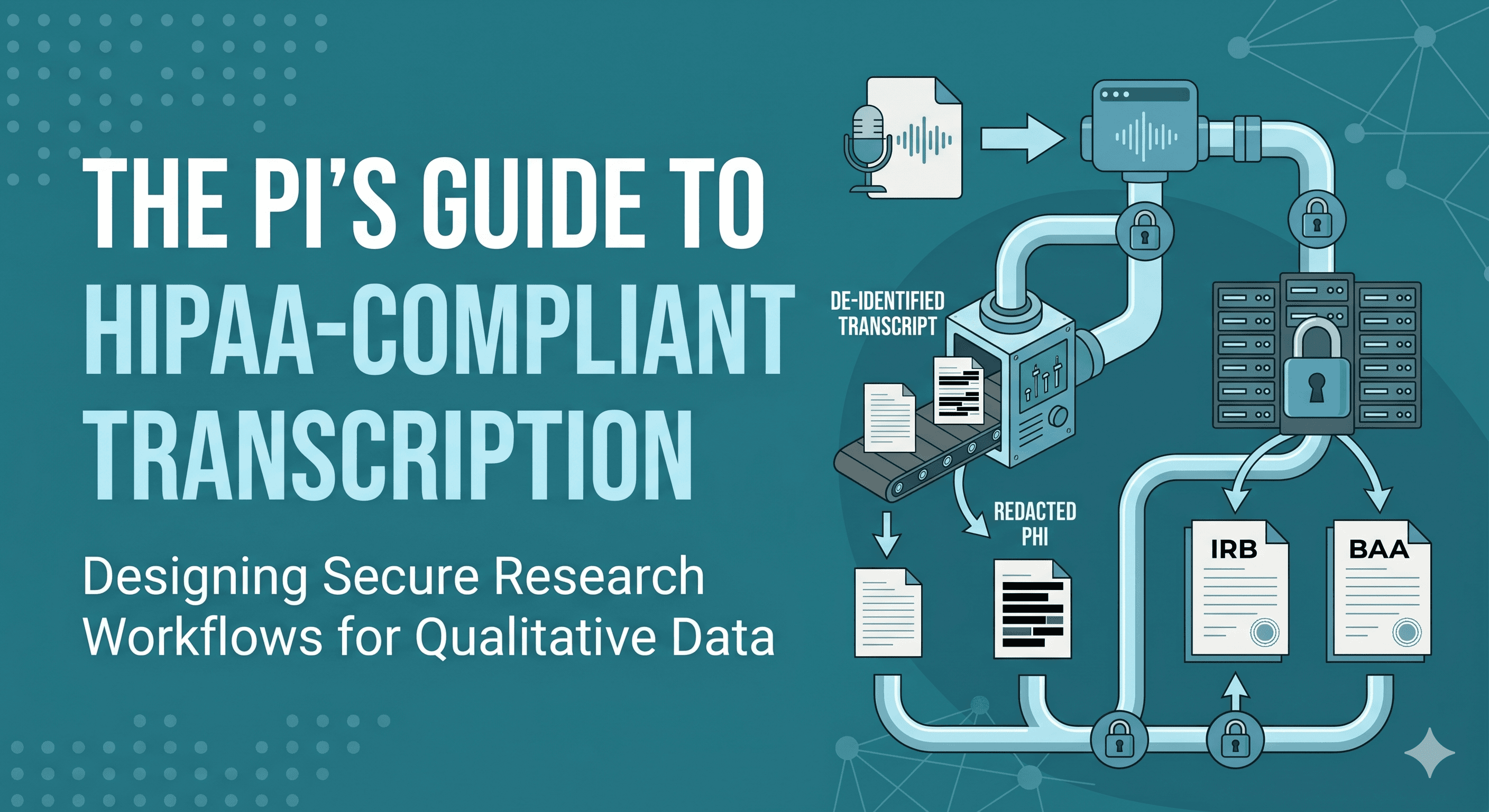
Why transcription is a HIPAA risk surface, not a footnote
From a PI’s perspective, transcription sits right where rich, identifiable narratives intersect with external vendors, cloud tools, and student assistants. Everything HIPAA cares about confidentiality, minimum necessary, audit trails crashes into “We just need these interviews typed up.”
The HIPAA Privacy Rule permits PHI use for research only under specific conditions (authorization or IRB/Privacy Board waiver), and requires an “adequate plan to protect identifiers from improper use and disclosure” plus a plan to destroy them when possible. The moment you send clinical interviews or focus group recordings to a transcription service or AI platform, you are extending that risk surface into another system and you are responsible for it as the PI.
Most IRBs and institutional HIPAA offices now expect explicit transcription and audio workflows in your protocol: what you record, where files live, who has access, which HIPAA transcription services you use, and how you will de-identify and destroy data.
HIPAA and research: when does it apply to your recordings?
Under HHS guidance, HIPAA’s Privacy Rule allows use/disclosure of PHI for research in three main ways:
With a HIPAA authorization signed by the participant.
With an IRB or Privacy Board waiver/alteration of authorization, if privacy risks are minimized with adequate protection and destruction plans.
With de‑identified data, either via Safe Harbor (removing 18 identifiers) or Expert Determination.
For research transcription HIPAA questions, the practical test is:
Are your audio files or transcripts PHI (individually identifiable health information)?
Is the data being created/handled by a covered entity or its business associate?
Examples where HIPAA compliant transcription is required:
Patient interviews or focus groups about diagnoses, treatments, or experiences at named facilities.
Clinician interviews that describe identifiable patients, even if the patient isn’t present.
Mixed‑methods clinical trials where audio is collected under a HIPAA authorization or waiver.
If you can truly de‑identify recordings or text before any external party sees them, you may fall outside HIPAA for the transcription step but de‑identifying audio is extremely difficult in practice. Voiceprints and casual remarks often contain identifiers, and IRBs routinely treat raw interview audio as PHI.
PHI transcription rules: what exactly are you protecting?
HIPAA defines Protected Health Information (PHI) as individually identifiable health information held or transmitted by a covered entity or business associate, in any form oral, paper, or electronic. For medical transcription HIPAA compliance, that means both the audio recording and the transcript are PHI if:
They contain health information (diagnoses, treatments, billing, clinical status), and
They include identifiers that can tie that information to an individual.
The Safe Harbor de‑identification standard lists 18 identifiers that must be removed, including:
Name; all geographic subdivisions smaller than a state; all elements of dates (except year) for dates directly related to an individual; phone, fax, email; SSN; MRN; health plan ID; account numbers; device IDs; URLs; IP addresses; biometric identifiers (including voiceprints); full‑face photos; and any other unique identifying characteristic.
For de‑identified transcription research, you have to consider these identifiers inside natural language and background chatter not just in metadata fields: introductions, jokes, “I live near that clinic in [ZIP code],” and so on.
The three HIPAA rules that shape transcription
From a PI’s perspective, three HIPAA rule sets determine your HIPAA transcription requirements:
1. Privacy Rule (what PHI can be used and why)
The Privacy Rule controls when and why PHI can be used or disclosed, including for research. For transcription, this means:
Your IRB‑approved plan must specify why you need recordings/transcripts with PHI.
You must apply minimum necessary: give transcriptionists only what they need, avoid unnecessary identifiers when possible, and don’t reuse PHI beyond your protocol.
2. Security Rule (how you protect ePHI)
The Security Rule covers electronic PHI (ePHI) and demands administrative, physical, and technical safeguards. For HIPAA data security transcription, this translates into:
Risk analysis of your audio/transcription data flows.
Encryption in transit and at rest.
Role‑based access controls and logging.
Policies and training for everyone handling recordings or transcripts.
3. Breach Notification Rule (what happens when something goes wrong)
If unsecured PHI is compromised, you must investigate and, if a breach is confirmed, notify affected individuals, clients, and regulators within mandated timelines (often within 60 days).
For transcription, this means your BAA transcription service provider must have a documented incident response plan and duty to notify you promptly so you can meet your obligations.
Designing a HIPAA‑compliant transcription workflow: PI’s step‑by‑step
What follows is a PI‑level workflow you can map directly into your IRB protocol, data security plan, and vendor contracts.
Step 0: Map your audio and transcription data flows
Before you write a single IRB line, sketch a simple data‑flow diagram:
Where and how is audio recorded? (platforms, devices, locations)
Where is it stored initially? (local device, clinical system, cloud)
How does it get to the transcription environment? (upload portal, SFTP, API)
Who touches it along the way? (research staff, clinicians, vendor staff, AI tools)
How is the transcript delivered back, stored, de‑identified, analyzed, and eventually destroyed?
University data security guidance explicitly recommends this kind of end‑to‑end mapping for human‑subjects research so you can choose appropriate controls at each step.
Step 1: Align IRB, HIPAA, and consent
Use HHS research guidance as your north star for qualitative research HIPAA compliance: PHI for research can be used under authorization, waiver, or de‑identification. When you write your protocol and consent:
Specify audio recording and transcription explicitly.
“Interviews will be audio‑recorded and transcribed by a HIPAA‑compliant transcription service under a Business Associate Agreement (BAA).”
Describe the data security plan in terms IRBs recognize: encrypted storage, access limits, retention/destruction timelines.
If you rely on a waiver of authorization, ensure your plan meets HIPAA’s three criteria for minimal risk to privacy: protect identifiers, destroy them as early as possible, and provide written assurances against reuse/disclosure.
Institutional examples (e.g., Duke, Purdue, UConn) explicitly tie audio/video capture, PHI handling, and encryption to IRB and HIPAA policies; your transcription workflow should align with this level of detail.
Step 2: Choose your recording stack and environment
For HIPAA compliant audio recording, select tools that either:
Live inside your covered entity’s HIPAA environment (e.g., telehealth platforms, EHR‑integrated recording), or
Are cloud tools under a HIPAA BAA with documented security.
Key decisions:
Platform: For remote interviews/focus groups, use institution‑approved platforms (e.g., HIPAA‑configured Zoom/Teams) with meeting passwords, waiting rooms, and controlled recording settings.
Hardware: Use digital recorders or encrypted laptops; avoid personal phones unless they are enrolled in institutional mobile device management and full‑disk encryption.
Environment: Instruct participants to join from private spaces; avoid stating full names during recording if strict anonymity is required.
Guidance from qualitative and telehealth literature emphasizes rehearsing recording logistics, confirming where files are saved, and backing up immediately to secure storage after each session.
Step 3: Decide on in‑house vs HIPAA transcription services
As a PI, you essentially choose between:
In‑house transcription inside your HIPAA environment
Staff or students transcribe using institutionally managed, HIPAA‑aligned tools and storage.
You manage training, access control, and QA.
External HIPAA transcription services (business associates)
A secure transcription partner operates under a dedicated BAA, utilizes their own audited physical and technical safeguards, and returns finalized transcripts directly to your secure environment. Specialized research-focused platforms like Ant is built accurately for this model handling human interview transcription, complex focus group cross-talk, and Safe Harbor redactions directly within a compliant pipeline.
Many academic PIs opt for external HIPAA interview transcription or focus group transcription when volume is high or deadlines are tight, but institutional HIPAA offices expect any such vendor to be vetted and formally contracted as a business associate.
Step 4: Make the BAA work for you (not just legal)
If a vendor touches PHI, they are a business associate and must sign a Business Associate Agreement (BAA) before you upload a single file. A robust BAA for HIPAA transcription services should:
Define exactly what PHI the vendor may access and for what purposes.
Require the vendor to implement Privacy, Security, and Breach Notification Rule safeguards, including risk analysis and minimum necessary controls.
Bind subcontractors (e.g., secondary transcriptionists or AI infrastructure) to identical obligations.
Spell out security incident and breach reporting timelines (“without unreasonable delay and no later than 60 days”).
Require secure return or destruction of PHI at the end of the engagement, with specific exceptions if destruction is infeasible.
IT and legal checklists stress that BAAs should be operational describing day‑to‑day access, storage, and destruction not just abstract legal language. As PI, you should be able to point to the BAA when a sponsor or auditor asks, “Who can see our participants’ transcripts, and how is that controlled?”
Step 5: Operationalize secure file transfer and access
Even with a great BAA, you can still blow compliance with sloppy operations. For HIPAA compliant audio transcription, PI‑level controls include:
Upload only through secure channels.
Use the vendor’s encrypted portal or SFTP; never email PHI or use consumer file‑sharing (uncontrolled links, public clouds).
Lock down who can upload and download.
Use named accounts, strong authentication, and separate roles for upload, review, and analysis.
Control local copies.
Prohibit saving PHI to personal desktops or USB drives; enforce storage only on institutionally managed, encrypted systems.
Log and review access.
Ensure both your institution and the vendor maintain audit trails of access to recordings and transcripts.
University data‑security guidance explicitly calls for documenting who has access to the data, how it is transmitted and stored, and how electronic consent and signatures are captured when relevant.
Step 6: Choose and configure human vs AI transcription (HIPAA edition)
This is where human transcription vs AI HIPAA decisions bite. Your options fall into three broad categories:
A. Human‑only, HIPAA transcription services
Traditional medical/research transcriptionists working under a BAA, with secure portals and strong training.
Pros: high nuance capture for qualitative data, no AI training concerns, easier to explain to IRBs.
Cons: higher cost, longer turnaround at large volumes.
B. AI inside your HIPAA environment
Use HIPAA‑configured ASR (automatic speech recognition) inside infrastructure you control (e.g., cloud platforms under a BAA, institutionally managed tools).
Pros: speed and cost efficiency; no PHI leaves environments already covered by existing BAAs.
Cons: you must prove to IRB/HIPAA that models and logs aren’t “training” on your PHI; requires stronger technical oversight.
C. Hybrid: AI draft + human QA in a HIPAA environment
AI generates a first pass; trained staff or a HIPAA‑bound vendor corrects and quality‑checks.
Increasingly common in encrypted transcription research at scale, especially when you need fast turnaround but can’t sacrifice nuance.
Research on AI transcription in health contexts shows that many popular cloud ASR tools are not HIPAA‑compliant out‑of‑the‑box; you must use specific HIPAA programs/tenants under BAAs and disable PHI retention or model training. If a tool won’t sign a BAA or can’t explain its PHI handling, you cannot route PHI through it.
Step 7: Build de‑identification and keys into the pipeline
Even if you start with PHI, you will often want de‑identified transcription for analysis, sharing, or publication. A robust de‑identification workflow for qualitative data:
Decide where de‑identification happens.
At the vendor: some HIPAA transcription services offer PHI redaction as part of their service under the BAA.
In‑house: your team redacts identifiers post‑transcription in secure tools.
Use the 18‑identifier Safe Harbor list as your checklist.
Redact names, locations below state level, full dates, contact details, MRNs, and voiceprints or full‑face descriptors that might re‑identify individuals.
Maintain a key file, separately secured.
If you need to link transcripts back to participants (e.g., for longitudinal follow‑up), maintain a separate mapping file stored in a more restricted location; never store it in the same workspace as de‑identified analytic files.
Guidance on sharing human‑subjects research data stresses that even de‑identified data can pose re‑identification risks, particularly in small or rare disease populations; IRBs may require additional controls for external sharing beyond Safe Harbor.
Step 8: Retention, destruction, and off‑boarding vendors
Finally, close the loop:
Retention: Align storage duration for recordings and transcripts with your IRB protocol, sponsor contracts, and institutional policy (e.g., “retain for 7 years after study closeout”).
Destruction: Document how and when audio and transcripts will be securely destroyed (e.g., vendor wipes data after 30–90 days, institution deletes local copies after analysis is complete).
Off‑boarding vendors: When a BAA transcription service relationship ends, ensure PHI is returned or destroyed as specified in the BAA, and revoke all access credentials.
Institutional standards for interview/audio PHI emphasize encryption of removable media, locked storage, check‑out logs, and erasing devices once data is safely transferred to secure storage. Your transcription off‑boarding should match this level of discipline.
Special cases: universities, multi‑site studies, and focus groups
Universities and academic medical centers
University HIPAA and IRB offices often publish research transcription HIPAA guidance that blends federal rules with local policy. Common themes:
PHI de‑identification requires removal of all 18 identifiers and sometimes more, especially for small populations.
External sharing even of de‑identified data may require Data Use Agreements or additional IRB review.
Data security plans must specify survey software, transcription services, and storage locations, plus who has access and how consent is captured.
As PI, expect to show reviewers: your BAA, data‑flow map, storage plan, and sometimes a sample transcript showing how identifiers will be redacted.
Focus groups and group interviews
Remote‑focus‑group guidance emphasizes:
Getting IRB approval to record audio/video and explaining recording in consent.
Using password‑protected meetings, practice recordings, and backup recorders to avoid data loss and privacy failures.
Reminding participants not to use each other’s full names during the session if strict anonymity is required.
For HIPAA interview transcription and focus groups, group dynamics increase re‑identification risk: multiple people may mention clinics, neighborhoods, or rare conditions. Build time into your de‑identification plan specifically for group transcripts, where cross‑talk and overlapping identifiers are common.
Practical vendor evaluation checklist for PIs
When you’re actively shopping for HIPAA transcription services or a secure medical transcription partner, move beyond marketing copy. Use a PI‑level checklist:
Compliance and security
Do you sign a BAA? Can I see a sample?
What encryption do you use for data in transit and at rest?
Where is data stored (country, cloud provider, data centers)?
How do you handle subcontractors and offshore staff, if any?
Can you provide recent risk assessments, audits, or certifications (e.g., SOC 2, HITRUST)?
How quickly do you notify clients about security incidents or breaches?
Research‑specific capabilities
Do you support de‑identified transcription research (redaction services, structured handling of IDs)?
Can you deliver speaker‑labelled transcripts suitable for qualitative coding (e.g., ID1, ID2)?
Do you avoid using client data to train general AI models? Several academic‑facing services explicitly commit: “Your files should never be used to improve someone’s language model.”
Can you sign NDAs and provide documentation suitable for IRB submission (data security statements, SOPs)?
Operational factors that matter in practice
Turnaround time options (rush vs standard) and scalability for multi‑site studies.
Support for encrypted transcription research via SFTP, VPN, or APIs.
Integration with your existing storage or analysis tools (secure export formats).
Red flags include: no BAA, vague answers about PHI scope, reliance on consumer clouds without HIPAA programs, and any suggestion that your recordings might be re‑used for “product improvement” or “analytics” without explicit authorization.
Common failure modes (and how PIs can prevent them)
From IRB and compliance case reports, the same failure modes appear again and again:
Shadow tools: A well‑meaning RA uploads PHI‑containing audio to a non‑HIPAA AI transcription app because “it’s faster.”
Email leaks: Transcripts with PHI are emailed to personal accounts or unencrypted attachments are forwarded to external collaborators.
Undefined vendor scope: A transcription vendor under a BAA quietly brings in sub‑contractors or offshore staff without the PI realizing the expanded risk.
No destruction plan: Audio sits on recorders, laptops, and vendor systems long after the retention period, increasing breach exposure.
As PI or study manager, you mitigate these by:
Explicitly banning non‑approved tools in your SOPs and training.
Using only HIPAA‑approved storage, collaboration, and AI platforms; routing everything else through de‑identified datasets.
Reviewing vendor BAAs and SOC reports yourself or with IT/security before starting.
Scheduling periodic audits of where your audio/transcripts live and enforcing destruction timelines.
Closing: Design Your Transcription Workflow Like a Method Section
If you want your qualitative or mixed-methods study to survive regulatory scrutiny, treat HIPAA-compliant transcription as seriously as your sampling plan or analytic framework.
By grounding your plan in the HIPAA Privacy, Security, and Breach Notification Rules, mapping every hop your data takes, and building in strict destruction timelines from day one, you do more than just stay compliant you protect your participants and strengthen the integrity of your research.
Streamline Your Protocol with Ant
If you are preparing an IRB submission or scaling up a qualitative study, you don’t have to build this compliance infrastructure from scratch. Ant acts as your dedicated, secure endpoint for research transcription, engineered specifically to map directly into a PI’s defensive data-security plan.
Here is how the platform aligns with the workflow out of the box:
100% Secure Human Transcription: Captures the complex nuance, cultural dialects, and overlapping cross-talk of focus groups with absolute accuracy—completely bypassing the model-training and data-retention risks of commercial AI tools.
Irrevocable BAA Infrastructure: We sign standard or institutional Business Associate Agreements (BAAs) that explicitly lock down data access, prohibit unsanctioned subcontractors, and enforce secure data return or military-grade destruction at study closeout.
Pipeline De-identification: Save your research assistants hours of post-processing. Our trained, vetted transcription team can redact the 18 Safe Harbor identifiers (and contextual location clues) directly during transcription.
Qualitative Framework Ready: Receive speaker-labeled, clean transcripts formatted specifically for direct import into qualitative analysis suites like NVivo, ATLAS.ti, or MAXQDA.
A Blueprint for Qualitative Compliance
The 8-step workflow outlined in this article isn't just theoretical, it is the exact operational framework engineered for the human-led research transcription pipeline at Ant.
Because every university IRB and clinical IT department operates under slightly different data-security mandates, we don't believe in one-size-fits-all compliance. If you are currently drafting a protocol, navigating a complex data-flow map, or need a transcription partner prepared to review and sign a strict institutional BAA, let's connect to configure a workflow tailored to your study.
