

How to Conduct Semi-Structured Interviews?
Key Takeaways
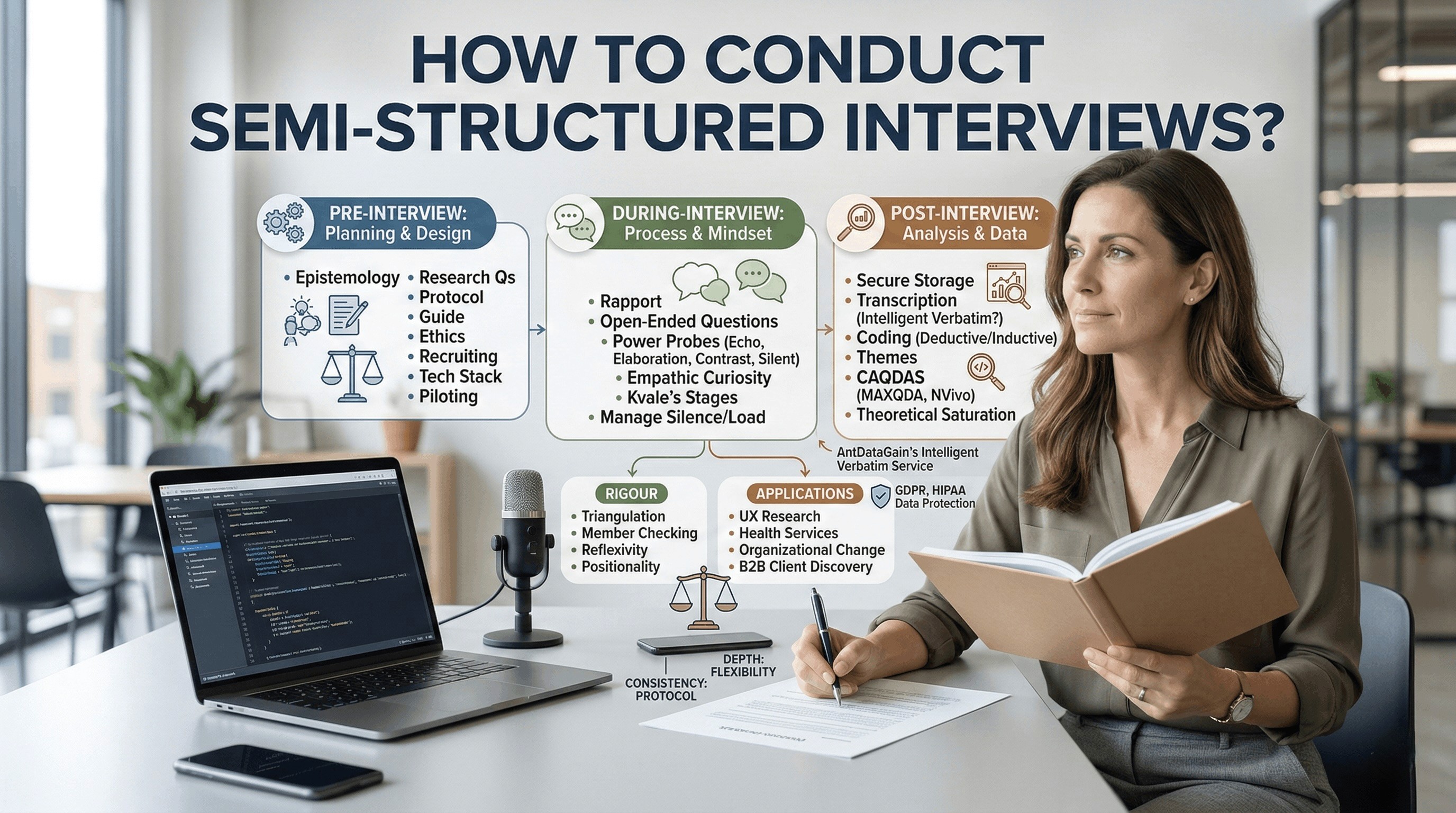
A semi-structured interview is a qualitative research method that uses a core interview protocol plus flexible follow-up probes to balance consistency and depth.
It is best used when you know your core topics but still need to explore how participants frame experiences in their own words (e.g., UX research, health services, organizational change).
The pre-interview phase focuses on clarifying epistemology and research questions, writing an interview protocol, piloting and iteratively refining your guide, and locking down recruitment, ethics, and tech stack.
During interviews, interviewers build rapport, use open-ended, non-leading questions, and deploy different probing types (echo, elaboration, contrast, silent probes) while managing cognitive load and silence.
Post-interview work includes reflexive memo writing, secure storage, choosing the right transcription style, coding data in CAQDAS tools (e.g., MAXQDA, NVivo alternatives), and progressing toward theoretical saturation.
Rigour is strengthened through triangulation, member checking, and explicit reflexivity and positionality statements that surface the researcher’s influence on data production and interpretation.
Practical burdens like verbatim transcription and secure data management can be outsourced (e.g., AntDataGain’s intelligent verbatim service) so researchers can focus on analysis and theory-building rather than admin.
What is a Semi-Structured Interview?
A semi-structured interview is a qualitative research method that combines a standardized interview protocol with open-ended, conversational questioning to generate rich, comparable data across participants. A semi-structured interview guide is a flexible set of core questions and topics that anchors each interview while allowing spontaneous follow-up probes based on participants’ responses.
Typology and Rationale: Where Semi-Structured Interviews Fit
Before detailing the pre-interview phase, it is essential to situate semi-structured interviews within the broader research methodologies spectrum.
The Three Modalities of Interviewing
Structured interviews: Highly rigid and standardized. The interviewer administers a fixed protocol with tightly constrained questions, prioritizing reliability and statistical comparability over depth. Best used in deductive, large-scale quantitative surveys where the variables are already strictly defined.
Unstructured interviews: Highly flexible and participant-led. The interviewer opens with a broad prompt and follows the participant’s narrative trajectory with minimal intervention. Best used in ethnographic studies or exploratory phenomenological research where predefined constructs might inappropriately bias the data.
Semi-structured interviews: The methodological middle ground. They utilize a core interview guide to ensure cross-case comparability while leveraging active probing to capture the nuances of participant meaning-making.
The Rationale: Balancing Consistency and Depth
Semi-structured interviews exist to resolve a specific methodological tension: the need to systematically compare data across a sample without imposing a rigid framework that strips away contextual depth.
Relying solely on structured methods risks missing the underlying mechanisms—the vital "how" and "why" behind participant behaviors. Conversely, purely unstructured interviews can yield highly divergent datasets that are exceptionally difficult to code and analyze systematically. The semi-structured approach bridges this gap. It provides enough standardization to support rigorous thematic analysis and theoretical saturation, while remaining epistemologically aligned with research paradigms that value the participant's own framing of their reality.
Strategic Use Cases and Applications
This modality is uniquely suited for scenarios where the core domains of inquiry are known, but the intricate mechanisms, motivations, or barriers remain opaque. Specific applications include:
UX research and product development: Investigating user mental models and workflows, allowing researchers to anchor questions on core tasks while immediately probing the reasoning behind specific user decisions.
Health services and implementation science: Mapping complex patient care pathways, or understanding the granular barriers and facilitators to adopting new clinical guidelines.
Organizational change: Eliciting candid narratives about workplace culture, employee sentiment, or operational friction during structural transitions.
B2B client discovery: Uncovering the nuanced, multi-stakeholder decision-making criteria used when evaluating new services, business models, or technologies.
(Note: For a high-level comparison of how these methods impact analytic ease, refer to the comparison table further down this guide).
Introduction and the Interviewer’s Mindset
Semi-structured interviews sit between fully structured and unstructured interviews: questions are anchored in a planned interview protocol, but their order, exact wording, and depth of probing vary according to the flow of each conversation. This structure-with-flexibility is why they are standard in contemporary qualitative research, clinical studies, UX research, and implementation science.
Epistemology Matters
A semi-structured interview is often used within interpretivist or constructivist paradigms, where the goal is to understand how people construct meaning rather than to measure fixed traits. The interviewer is not a neutral data-collection instrument but a co-constructor of knowledge whose questions, responses, identity, and positionality shape what is said and what is left unsaid.
Interviewer Mindset: “Empathic Disciplined Curiosity”
Curious but focused: stay rooted in the research question and interview protocol while following promising tangents.
Non-judgmental and reflexive: notice your own reactions, assumptions, and power dynamics as data, not noise.
Conversational but rigorous: the interaction may feel like natural conversation, but the interviewer is deliberately using open questions, probes, and pacing to elicit analyzable material.
Interviewer Pro‑Tips
Practice active listening with minimal encouragers (“mm‑hm,” “I see”) rather than long paraphrases that may reframe the participant’s meaning.
Keep a printed copy of your interview protocol with space for notes; mark where you deviated and why for later reflexive memos.
Pre‑Interview Phase: Planning and Design
Clarify Epistemology, Objectives, and Research Questions
Before drafting questions, clarify what kind of knowledge your study is trying to produce (epistemology) and what phenomena you want to explain or understand.
If your study is exploratory (e.g., grounded theory), semi-structured interviews support generating categories and concepts inductively, progressing towards theoretical saturation.
If the study is more deductive (e.g., testing a framework), the interview protocol should map explicitly to constructs and hypothesized mechanisms, which will later be mirrored in thematic coding.
Write 1–3 clear research questions, then derive high-level interview domains (e.g., “care pathway,” “decision-making,” “barriers and facilitators”). These domains will anchor your interview protocol and your later qualitative data analysis.
The Interview Protocol vs. Interview Guide
An interview protocol is the formal procedural framework for how interviews will be conducted—covering sampling strategy, consent procedures, recording, timing, and standardized steps before, during, and after each interview. An interview guide is the content-focused checklist or aide-mémoire of questions and topics to be covered within each interview.
The protocol specifies stages (e.g., welcome script, consent, warm-up, core sections, debrief) and is tightly aligned with Kvale’s seven stages of interviewing (thematizing, designing, interviewing, transcribing, analyzing, verifying, reporting).
The guide sits inside that protocol and is refined iteratively based on piloting and emerging insights; it “does” the work of structuring conversation while preserving flexibility.
Treat the protocol as your SOP for reproducible practice and your guide as a living tool you improve after the first 2–3 pilot interviews—this iterative refinement is essential to catch missing topics, confusing questions, or overlong sections.
Designing Questions and Probes
Best practice is to design core questions that are open-ended, neutral, jargon-free for participants, and sequenced from broad to specific.
Common question types in semi-structured interviewing include:
Grand tour questions – broad, experience-based openers (“Can you walk me through a typical day in…?”).
Core questions – 5–10 questions directly addressing your research objectives that every participant is asked.
Planned follow-up questions – written probes attached to core questions to elicit detail (“What made that difficult?” “Who else was involved?”).
Unplanned follow-up questions – spontaneous probes that build on what the participant just said (“You mentioned feeling isolated—could you tell me more about that?”).
To avoid overloading participants, design questions that address one idea at a time and avoid double-barrelled phrasing or embedded value judgments, which can increase cognitive load and bias responses.
Ethics, Consent, and Positionality
Semi-structured interviews often elicit personal narratives, potentially involving clinical, workplace, or politically sensitive topics, so robust ethics and reflexivity are essential.
Draft an informed consent process that covers purpose, recording, confidentiality, data storage, and options to withdraw quotes.
Write a positionality statement that makes explicit your social location, professional role, and potential power relations with participants, then reflect on how this might shape recruitment and interaction.
Engage in ongoing reflexivity—a structured practice of interrogating your assumptions and how they shape questions, rapport, and interpretation, from design through reporting.
Sampling, Recruitment, and Theoretical Saturation
Sampling in semi-structured interview studies is usually purposive rather than random: you recruit participants who can speak meaningfully to your research questions.
Define inclusion and exclusion criteria and recruitment channels (clinics, customer lists, professional networks, online communities).
Plan an initial target sample but be guided by theoretical saturation—the point at which additional interviews stop generating new codes, themes, or insights relevant to your theoretical categories.
Saturation is evaluated analytically by tracking when new interviews cease adding genuinely new concepts rather than mere repetitions of existing categories.
Tech Stack and Logistics
A modern semi-structured interview workflow typically uses:
Scheduling tools and templated confirmation emails.
Reliable recording (Zoom/Teams/local recorder + backup).
Secure cloud storage with access controls for recordings and transcripts, compliant with GDPR/HIPAA where applicable.
CAQDAS software (e.g., MAXQDA and similar tools) for coding and thematic analysis once transcripts are ready.
10‑Point Pre‑Flight Checklist (Researcher-Ready)
Research questions and epistemological stance are written and agreed within the team.
Interview protocol (procedures) is documented, including consent, recording, and debrief steps.
Interview guide domains and core questions are mapped directly to research questions and planned analytic approach.
Question wording is open-ended, neutral, and checked for double-barrelled or leading phrasing.
Planned probes are drafted (e.g., “Can you give me a concrete example?”) and attached to each core question.
Pilot interviews (2–3) are scheduled and flagged as opportunities for iterative refinement of the guide.
Consent materials and ethics approvals (where required) are finalized, including data security and retention plans.
Recording, storage, and backup workflows are tested end-to-end.
A transcription strategy (intelligent vs full verbatim, in‑house vs external provider) is chosen in advance.
Reflexivity log or memo template is prepared to capture positionality reflections after each interview.
During the Interview: Process, Probing, and Silence
Opening the Interview and Building Rapport
Start every interview by following your protocol: introductions, confirming consent, reminding participants of the purpose, and explaining what will happen with their data. A calm, transparent opening reduces anxiety and supports more candid sharing.
Rapport-building is central in semi-structured interviews because trust directly affects the depth and authenticity of responses. Good practice includes:
Warm-up questions that are easy and non-threatening.
Active listening, eye contact (or vocal equivalents online), and responsive back-channel cues.
Explicit permission-giving (“It’s completely fine to pause and think before answering”).
Interviewer Pro‑Tips
Use a brief “meta” preface: “I’ll be looking down sometimes to take notes so I don’t miss your wording—that doesn’t mean I’m not listening.”
State how long the interview will last and check in halfway to respect cognitive and emotional load.
Probing Techniques: Getting Depth Without Leading
High-quality probing differentiates semi-structured interviews from surveys or rigid structured interviews. Probes invite elaboration, clarification, or concrete examples without shifting the participant’s meaning.
Key probe types and example “power probes” include:
Echo probe – Repeat a salient phrase with a questioning intonation to encourage elaboration. (Power probe: “You said it felt ‘overwhelming’… ‘overwhelming’ in what way?”)
Elaboration probe – Ask for more detail, stories, or context. (Power probe: “What was going through your mind at that exact moment?”)
Clarification probe – Resolve ambiguity. (Power probe: “When you say ‘support,’ what does that look like in practice?”)
Contrast probe – Explore differences across situations, time, or people. (Power probe: “How was that different from earlier experiences you’ve had?”)
Silent probe – Use deliberate, comfortable silence after an incomplete or emotionally loaded response, signalling that more is welcome. (Power probe: non-verbal gentle nod + open posture + wait 3–5 seconds.)
Example Probe Code Block (Copy‑Paste Ready)
Can you walk me through what happened, step by step?
What made that particularly challenging for you?
Can you give me a recent example that captures what you just described?
If I were watching this situation on a video, what would I actually see and hear?
Looking back now, what (if anything) would you have wanted to be different?
Studies on qualitative interviewing consistently recommend treating follow-up probes as equal in importance to the core questions because they often surface the most analytically rich material. Build planned probes into your guide, but stay alert for unexpected phrases or metaphors that merit on-the-spot probing.
The “Nudging” Technique and Non-Verbal Cues
Non-verbal “nudging”—the nod, slight head tilt, and attentive posture—is a subtle but powerful way to encourage fuller answers without adding leading content. A gentle nod and “mm‑hm” after a pause signals that the participant is not being rushed and that more detail is welcome.
However, non-verbal behaviour also carries risk: overly enthusiastic nodding or visible approval can steer participants toward what they think you want to hear, undermining neutrality. Reflexive awareness of your own body language is therefore part of ethical and rigorous interviewing practice.
Managing Silence and Cognitive Load
Silence is not a problem to be fixed; it is often where reflection and deeper meaning-making happen. Interviewers new to qualitative work often interrupt silences too quickly, cutting off narratives that were about to become more nuanced.
From a cognitive load perspective, stacking multiple questions or time frames into one turn (“Why did you do that and how did your team respond and what did you learn from it?”) overloads working memory and pushes participants toward short, shallow answers. Instead:
Ask one question at a time.
Move from descriptive (“What happened?”) to interpretive (“How did that affect you?”) to evaluative (“Looking back, how do you feel about that?”).
Use silence strategically: ask, then count slowly to five before considering a rephrase.
The Expert’s Sidebar – Common Pitfall: Interrupting Silence Too Quickly
Many interviewers equate silence with failure and rush to “rescue” participants with leading suggestions. In practice, a 3–5 second pause often precedes the most insightful material of the interview. Train yourself to tolerate and even welcome productive silences. Watch participants’ non-verbal cues: if they are thinking (eyes up, brows knit), hold the space; if they look genuinely stuck, offer a gentle scaffold such as, “Take your time—maybe think of a recent example.”
Kvale’s Seven Stages: Structuring the Whole Process
Kvale and Brinkmann describe seven stages of an interview inquiry—thematizing, designing, interviewing, transcribing, analyzing, verifying, and reporting—which provide a useful backbone for semi-structured interview projects.
During interviewing, stay aware of downstream analytic needs: clarify meanings, ask for concrete examples, and check interpretations with participants (“So if I’m hearing you right, X…?”). This anticipatory orientation makes later coding and theme development much easier and improves the credibility of findings at the verifying and reporting stages.
Note‑Taking, Memoing, and Reflexivity In-Session
While recording captures verbatim content, brief field notes and reflexive memos capture context (setting, mood, interruptions) and your own reactions, which are vital in interpretation.
Jot down keywords, notable quotes, and non-verbal observations without breaking eye contact for too long.
Immediately after the interview, write a reflexive memo: your impressions, emotional tone, emerging patterns, and any discomfort or surprise that might signal your own assumptions.
These memos are core data for reflexivity and positionality, making transparent how your lens may have shaped questions and interpretations.
Structured vs Semi-Structured vs Unstructured Interviews
Use this high-level comparison when justifying your choice of method in protocols and publications.
Feature | Structured Interview | Semi-Structured | Unstructured |
Flexibility | Low | High | Very High |
Analysis Ease | High | Medium | Low |
Best Use Case | Large-scale surveys | Deep UX/social research | Discovery/ethnography |
Post‑Interview: From Audio to Analyzable Data
Data Security, GDPR/HIPAA, and Professionalization
Handling semi-structured interview data requires rigorous data protection, especially when dealing with health, employment, or other sensitive topics.
Store recordings and transcripts on encrypted drives or secure cloud platforms with access controls and clear retention timelines, aligned with GDPR and HIPAA where applicable.
Separate direct identifiers from working datasets and maintain a secure key list.
Document these procedures in your protocol and ethics submissions.
Manual transcription is often the bottleneck: an hour-long interview can easily take 4–6 hours to transcribe accurately, especially if you are capturing non-native accents, overlapping speech, or technical terminology. This is where AntDataGain’s intelligent verbatim service can realistically save weeks across a multi-interview project, while ensuring transcripts are handled via encrypted, privacy-compliant workflows that meet or exceed GDPR/HIPAA standards.
Choosing Transcription Type: Full vs Intelligent Verbatim
Transcription is not a neutral step; it is an interpretive act that shapes what you will later “see” in the data.
Common options:
Full verbatim transcription – captures every word, filler, hesitation, and false start; useful for conversation analysis or detailed discourse work but slower and harder to read.
Intelligent verbatim transcription – removes obvious fillers and non-meaningful repetitions while preserving wording, sequence, and meaning; usually preferred for thematic or content analysis because it balances fidelity and readability.
Summarized or topic-focused transcription – structured summaries keyed to your guide; faster but less suitable for fine-grained coding.
Align your choice with your analytic approach (e.g., grounded theory vs rapid assessment) and explicitly note it in your methods section for transparency.
Interviewer Pro‑Tips
Decide your transcription style before data collection so instructions to any transcription provider are consistent.
If using external services, ensure NDAs and data processing agreements explicitly cover encryption, retention, and jurisdiction.
(Insert internal link placeholder: See also: Transcription Styles for Qualitative Research – Blog.)
Qualitative Data Analysis, Coding, and Thematic Development
Once you have transcripts, move systematically into qualitative data analysis. Most semi-structured interview projects employ some combination of coding and thematic analysis.
Typical workflow:
Familiarization – read each transcript while listening to audio, making margin notes about initial ideas and patterns.
Initial coding – assign short labels (codes) to meaningful segments (phrases, sentences, or paragraphs) that relate to your research questions; this can be inductive (emergent) or deductive (based on theory).
Code grouping – cluster related codes under higher-level categories and begin sketching relationships between them.
Theme development – integrate categories into broader themes that explain key patterns, tensions, or processes across participants.
Review and refinement – test themes against the full dataset, looking for disconfirming evidence and ensuring each theme is internally coherent but distinct from others.
Computer-assisted qualitative data analysis software (CAQDAS) such as MAXQDA and other tools can facilitate coding, memoing, and tracking relationships between codes and cases, but analytic judgement remains the researcher’s responsibility.
Theoretical Saturation and When to Stop Interviewing
Theoretical saturation is the point in qualitative analysis when further data collection no longer yields new themes, categories, or theoretical insights; additional interviews simply repeat what is already well-represented in your coding and memos.
Conceptualizations of saturation distinguish between:
Theoretical saturation – no new properties of theoretical categories are emerging; grounded theory focus.
Inductive thematic saturation – no new codes or themes are identified in the data.
Data saturation – new data mostly replicate previous responses.
Plan to review saturation iteratively (e.g., after every 3–5 interviews) and document your reasoning—this becomes part of your rigour narrative in publications.
Triangulation and Member Checking
To bolster trustworthiness, integrate semi-structured interview data with other data sources and engage participants in member checking where appropriate.
Triangulation: compare interview themes with survey findings, observational notes, or document analysis to test convergence, complementarity, or dissonance.
Member checking: return transcripts, summaries, or preliminary interpretations to participants to confirm accuracy, invite corrections, or surface misinterpretations; this can build trust and credibility when handled sensitively.
Neither triangulation nor member checking is a mechanical guarantee of “truth,” but together with reflexivity, they demonstrate serious attention to qualitative rigour.
Advanced Troubleshooting and FAQs
Advanced Troubleshooting: Recurring Problems and Fixes
Problem: Participants give very short answers despite open questions.
Possible causes: social anxiety, unclear purpose, power dynamics (e.g., student vs professor), or overly abstract questions.
Fixes: move to more concrete prompts (“Tell me about the last time…”), explicitly normalize detail (“The more stories you can share, the more helpful this is”), and adjust your non-verbal nudging.
Problem: The conversation drifts far from your research question.
Possible causes: overly broad grand tour questions, lack of transitions between guide sections, or interviewer reluctance to redirect.
Fixes: use soft steering phrases (“That’s really helpful. I’d like to bring us back to…”) and rely on your guide’s topic headings as anchor points.
Problem: Emotionally intense disclosures you did not anticipate.
Possible causes: topic sensitivity, rapport, or your own identity aligning with vulnerabilities.
Fixes: prioritize participant wellbeing, offer breaks, remind them of their right not to answer, and follow your protocol for distress and safeguarding; debrief yourself via reflexive memo afterwards.
The “Power Probe” List – Five Magic Phrases
Use these flexible prompts across domains (UX, health, organizational research) to deepen responses without leading:
“Can you walk me through what happened, step by step?”
“What was going through your mind at that exact moment?”
“Can you give me a concrete example that really captures what you mean?”
“How did that affect what you did next?”
“If you were explaining this to a close friend, how would you tell the story?”
Each of these aligns with best-practice recommendations to prioritize “how” and “what” questions over “why” questions, which can elicit defensiveness or post‑hoc rationalizations.
Frequently Asked Questions (FAQs)
1. When should I use a semi-structured interview?
Use a semi-structured interview when you need both comparability across participants and space for unexpected insights—for example, in early-stage product discovery, implementation research, or exploring experiences of care. It is less suitable when you require standardized responses for statistical comparison (structured survey) or when you want participants to set the agenda almost entirely (fully unstructured or narrative interviews).
2. How many semi-structured interviews do I need?
There is no universal number; instead, sample size is guided by theoretical or thematic saturation—the point where additional interviews stop adding new categories or insights. Many qualitative studies report saturation in the range of 10–30 interviews per relatively homogeneous group, but complex, multi-site or multi-stakeholder studies may need more.
3. How long should a semi-structured interview last?
Semi-structured interviews commonly run for 30–60 minutes to balance depth with participant fatigue. Longer sessions are possible for in-depth life-history or clinical work but may require breaks and additional ethical considerations.
4. How do I analyze semi-structured interview data?
Most researchers use a combination of coding and thematic analysis: coding segments of text, grouping codes into categories, then developing themes that answer the research questions. CAQDAS tools can support this process, but careful reading, memoing, and iterative refinement remain central.
5. What is the difference between an interview protocol and an interview guide?
An interview protocol is the procedural backbone of your study, covering recruitment, consent, interview stages, and post-interview steps. An interview guide is the content roadmap of questions and topics that sits within that protocol and is iteratively refined as you learn from early interviews.
6. How does reflexivity and positionality influence semi-structured interviews?
Reflexivity is the ongoing practice of examining how your identity, assumptions, and power relations shape every stage of the study, from design to interpretation. Positionality statements make these dynamics explicit for readers, while reflexive memoing helps you track how your perspective may have guided questioning, rapport, and analysis decisions.
7. Can I combine semi-structured interviews with surveys or analytics?
Yes—semi-structured interviews are frequently triangulated with surveys, usage analytics, or observational data to contextualize numerical patterns and deepen explanatory power. This mixed-methods approach is particularly powerful for UX, implementation, and policy studies.
Conclusion and Next Steps
A semi-structured interview is not just “a list of questions”; it is a disciplined, reflexive, and iterative process that stretches from epistemological choices through Kvale’s seven stages to rigorous thematic analysis and transparent reporting. By investing in a robust interview protocol, training interviewers in probing and silence, and professionalizing downstream tasks like transcription and secure data handling, teams can generate publishable-quality qualitative insights at scale while reducing researcher burnout.
