

Data Security in Qualitative Research
You’ve just spent six months traveling across the country, conducting one-on-one interviews with survivors of workplace harassment. You have 50 hours of raw audio sitting on a flash drive in your backpack. You stop at a coffee shop to grab a quick latte, turn your back for ten seconds, and your backpack is gone.
If that flash drive isn't properly secured, you haven't just lost your hard work—you’ve exposed the identities and traumatic experiences of dozens of vulnerable people to the public. You have caused a data breach in a research study, a serious compliance failure that can ruin lives, destroy your career, and shut down your institution's funding.
Welcome to the critical practice of data security in research.
If you are a Principal Investigator (PI), a grad student, or a member of an Institutional Review Board (IRB), you already know that protecting participant information isn't just a box to check—it's the ethical foundation of your work. But qualitative research presents a unique set of challenges. Unlike quantitative data, which often looks like rows of harmless numbers in a spreadsheet, qualitative data is complex, unstructured, and highly personal. It involves voices, faces, personal stories, and identifying details that are incredibly hard to mask. (If you are still finalizing your interview protocols, check out our practical guide on mastering qualitative interview techniques before proceeding).
In this practical guide, we will explore exactly how to achieve rigorous data security in a qualitative study. From getting your IRB approval to navigating the complexities of GDPR and HIPAA, handling vulnerable populations, and finally, my personal advanced strategies for locking down your workflow, this post covers it all. Let's establish strict protocols to secure your data.
Key Takeaways: Research Data Protection
Anonymity vs. Confidentiality: Qualitative research almost exclusively relies on confidentiality (protecting known identities), not anonymity (having zero identifying data).
IRB Compliance: Ensure informed consent clearly outlines data access, storage on AES-256 encrypted drives, and an exact timeline for final data destruction.
The "Bus Factor": Always establish a Data Succession Plan so encrypted data is not permanently lost if the primary researcher is incapacitated.
Data Lifecycle Security: Never use email to share sensitive files; rely strictly on university-approved, HIPAA/GDPR-compliant cloud portals.
De-Identification: Scrub both direct identifiers (names, numbers) and indirect identifiers (highly specific biographical details) before analysis.
Table of Contents
Why Qualitative Data is Uniquely Vulnerable
Confidentiality vs Anonymity in Research
Navigating IRB Data Security Requirements
Regulatory Requirements: GDPR and HIPAA
The Data Lifecycle: Step-by-Step Protection
Pre-Analysis: De-Identification and QDA Software
The Veteran Researcher's Advanced Strategies
Frequently Asked Questions (FAQs)
Why Qualitative Data is Uniquely Vulnerable
Before we explore the "how," we need to understand the "why." Protecting sensitive research data in qualitative studies requires a fundamentally different approach than in quantitative studies. Here is why:
Richness of Data: Qualitative interviews are designed to be detailed. Participants share specific names, dates, locations, and events. Even if you remove their actual name, the story itself can easily identify them. This is often referred to as "deductive disclosure."
Media Formats: We deal with massive audio files, video recordings, and hundreds of pages of transcripts. A raw video file or a unique voice recording cannot be easily anonymized before it is safely stored.
The Human Element: Qualitative teams often involve transcriptionists, translators, and multiple coders. Every time a file changes hands, or is moved between devices, the risk of a leak increases exponentially.
As qualitative researchers, we are asking people to trust us with their truths. In return, we owe them absolute dedication to research participant privacy.
Confidentiality vs Anonymity in Research
One of the most common mistakes I see in IRB applications and a major red flag for reviewers is researchers mixing up the words "confidentiality" and "anonymity." If you promise anonymity when you can only guarantee confidentiality, you are starting your project on a legal and ethical lie.
To ensure absolute compliance, researchers must understand the fundamental differences between confidentiality and anonymity.
The following table breaks down the core differences to keep you compliant:
Feature | Anonymity | Confidentiality |
|---|---|---|
Who knows the identity? | Nobody. Not even the researcher knows who the participant is. | The researcher knows who the participant is, but promises not to tell anyone else. |
How data is collected | Unsigned, untracked online surveys or blind drop-boxes. | Face-to-face interviews, Zoom calls, or signed consent forms. |
Is it common in qualitative work? | Very rare. Qualitative work usually requires direct human interaction. | Very common. This is the standard for almost all qualitative studies. |
What happens to the data? | No identifiers are ever attached to the data at any point. | Identifiers (like names) are collected but kept securely separate from the actual data. |
In short: Unless you are collecting data via an untraceable, anonymous web link where you literally never see the person, record their voice, or know their name, you are dealing with confidentiality, not anonymity. Your job is to keep their known identity a secret.
Navigating IRB Data Security Requirements
The IRB or your local ethics committee exists to protect human subjects. When they read your application, their primary concern is research ethics data protection. They want to know exactly what will happen to the participant's data from the moment they say "hello" to the moment the study is published and the files are deleted.
1. Informed Consent Data Security
You must tell participants exactly how you will protect their data before they agree to talk to you. This is called informed consent data security. Your consent form cannot rely on technical jargon. It must clearly state:
Access: Who will have access (e.g., "Only the core research team").
Storage: Where the data will live (e.g., "On a secure, locked university computer system").
Lifecycle: When the data will be destroyed.
2. Physical Security
If you take handwritten notes, print out consent forms (which have signatures and real names), or use physical flash drives, where do they live? You need to state that all physical documents will be stored in a locked filing cabinet, inside a locked office, accessible only by the primary researcher.
3. Digital Security Protocols
This is where the bulk of IRB data security requirements focus. You need to explain your encryption methods and your cloud storage choices. Never just say "I will save it on my computer." You must say "I will store the data on an AES-256 encrypted external hard drive that remains locked in a drawer."
4. The Data Succession Plan (The "Bus Factor")
Veteran PIs know that life is unpredictable. If the primary researcher is incapacitated, and they are the only person who holds the master password to the AES-256 encrypted drive, the data is permanently lost—or worse, unmanageable. Modern IRBs increasingly require a "Data Succession Plan" designating a secondary, trusted custodian (like a department chair or a senior co-PI) who has emergency access to the encryption keys via a sealed physical vault or a secure digital password manager.
5. Vulnerable Populations and Elevated Risk
If you are working with vulnerable populations—such as undocumented immigrants, victims of abuse, or political dissidents—standard security is not enough. If researching highly sensitive topics in the US, your IRB may require you to apply for a Certificate of Confidentiality (CoC) from the NIH, which legally protects you from being forced to hand over identifiable data to law enforcement.
Regulatory Requirements- GDPR and HIPAA
GDPR Qualitative Research Rules
If you are collecting data from citizens of the European Union (EU), you must follow the General Data Protection Regulation (GDPR). GDPR qualitative research compliance requires a fundamental shift in how you manage data.
Under GDPR, participants generally have the "Right to be Forgotten" (Article 17). While there are specific exemptions for scientific research if deletion would "seriously impair" the study, your default data management plan must be built to accommodate deletion requests easily during the active phases of your research.
Cloud Storage HIPAA Research Rules
If you are doing qualitative research involving protected health information (PHI) in the United States, you fall under the Health Insurance Portability and Accountability Act (HIPAA).
When it comes to cloud storage HIPAA research, you cannot just use a standard free Google Drive or personal Dropbox account. You must use an enterprise-level cloud storage provider that has signed a Business Associate Agreement (BAA) with your university or research institution.
The Data Lifecycle: Step-by-Step Protection
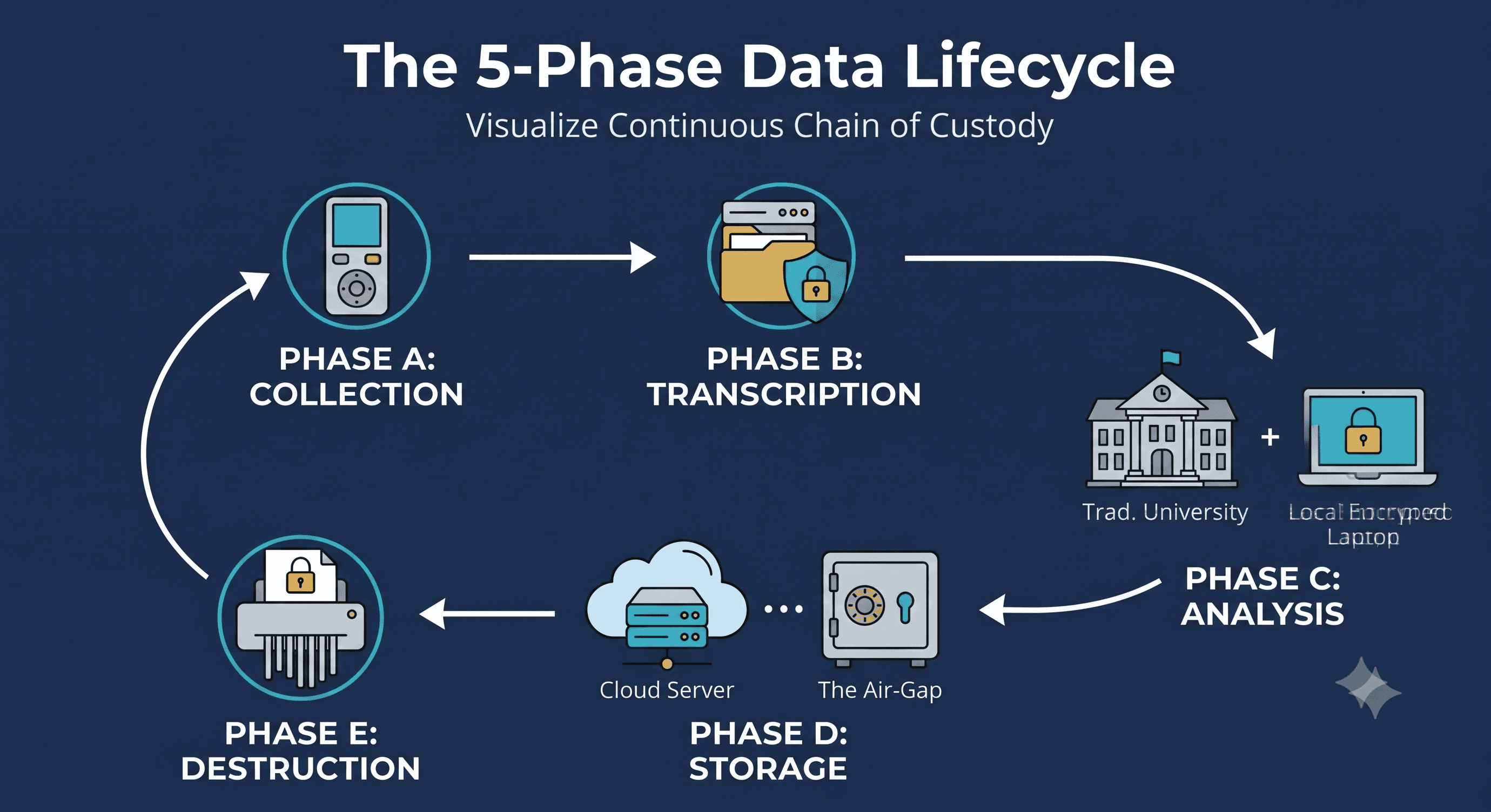
Securing data is a continuous, unbroken chain of custody. Let's break down how to maintain research data protection at every single stage.
Phase A: Data Collection and Audio Recording
The moment you hit "record," you are creating a sensitive document. Audio recording security in research starts with your equipment. Smartphones automatically back up to personal clouds (like iCloud), meaning your highly sensitive interview just got uploaded without your explicit control. Use a dedicated digital voice recorder that does not connect to the internet.
Phase B: Transcription and Translation
This is historically the most dangerous phase. You are transmitting secure audio to third parties.
The Strict Rule Against Emailing Transcripts: Historically, researchers attempted to secure files by relying on password protected transcripts placed inside ZIP files and sent via standard email. We must strongly advise against this outdated method. While password protection is a good secondary measure, email itself is inherently insecure.
The Secure Solution: Require your human transcriptionist (who has signed an NDA) to upload their finished transcripts directly into a secure, university-approved encrypted file-sharing portal. Do not use email for file delivery at any stage.
AI Transcription Services: Only use AI transcription tools explicitly vetted and approved by your IT department. Free online tools often use your audio to train their models, which violates participant confidentiality.
Pre-Analysis: De-Identification and QDA Software
Before any data goes into your qualitative software, it must be cleaned. This is the phase where you apply rigorous anonymization of qualitative data and de-identification in qualitative research.
Assign Pseudonyms: Give your participant an alphanumeric code (e.g., P-001).
The Master Key: Create a separate spreadsheet linking the real name to the fake name. Never store the Master Key in the same folder or device as the transcripts.
Media-Level Redaction (Video/Audio): If your study design requires you to retain the raw media for longitudinal analysis, you must alter the media itself. Use professional software to blur participant faces in video files, and use pitch-shifting tools to alter the frequency of their voices in audio files before saving them to your long-term storage vault.
Scrubbing Indirect Identifiers: If your participant says, "I was the only female mechanical engineering professor hired at [University] in 2012," simply changing the university name isn't enough. You must broaden the data: "I was one of the few female engineering professors hired at a large university around that time."
Data Analysis and Team Collaboration
If you are working with co-authors, you need a resilient system for secure file sharing within the research team. (Read our deep-dive on collaborative thematic analysis frameworks). Use a centralized secure server space where access can be granted and revoked centrally.
QDA Software Security Details: When importing data into Qualitative Data Analysis (QDA) software like NVivo, ATLAS.ti, or MAXQDA:
Local Saving: Save the master project file locally on your encrypted hard drive, not in a default public "Documents" folder.
Cloud Sync Risks: Be highly cautious of using built-in cloud collaboration features unless your university's IT department has explicitly approved a BAA or data processing agreement with the software vendor.
Phase E: Secure Data Storage Research
Where does the data live while you are writing? Secure data storage in research should follow the 3-2-1 Rule: Keep 3 copies of your data, on 2 different media types, with 1 copy offline. All digital storage must utilize full-disk encryption (e.g., BitLocker or FileVault).
Combating "Bit Rot" in Long-Term Storage: Many researchers lock an encrypted flash drive or Solid State Drive (SSD) in a safe, intending to meet their 5-year data retention requirement. However, unpowered flash memory degrades over time—a phenomenon known as "bit rot." Within 3 to 5 years, the magnetic charge can decay, turning your encrypted drive into an unreadable brick. To prevent this, you must physically power on your backup drives at least once a year, and ideally migrate the data to fresh hardware every 3-4 years.
Phase F: Final Destruction
When the study is over, you must destroy the data using a "secure wipe" program that overwrites the file multiple times with random garbage data.
Researcher's Advanced Strategies
After decades in the field, we’ve developed a few structural protocols that drastically reduce risk.
Protocol 1: The "Burner" Laptop for Fieldwork
When I travel to sensitive locations, I bring a cheap, secondary laptop. I do not log into my personal email on this device. When I record an interview, I transfer the audio to this laptop, encrypt it, and use a secure VPN to upload it to my university server. (Always verify with IT that foreign VPN connections won't trigger a security lockout). Once uploaded, I secure-wipe the local file.
Protocol 2: The Transcription Route (Local AI vs. Managed Platforms)
Manual transcription takes hundreds of hours, and public cloud AI is too risky for sensitive data. You generally have two secure options for moving from audio to text.
The first is the "DIY" technical route: running an open-source AI model locally. By downloading tools like OpenAI's "Whisper" directly to your machine, the AI transcribes using your computer's internal processing power. The audio file never connects to the internet, drastically mitigating cloud exposure.
However, many PIs prefer not to troubleshoot software or lack the technical bandwidth to set up local command-line environments. The alternative is utilizing a managed, IRB-compliant transcription platform. For instance, services like Ant are specifically tailored for qualitative researchers and social scientists. Rather than passing your data through public AI servers, they provide a closed, encrypted portal designed to natively meet HIPAA and GDPR standards. It serves as a secure, silent bridge between your raw data and your analysis, handling the compliance documentation so you can focus entirely on the research.
Protocol 3: The "Two-Vault" Codebook System
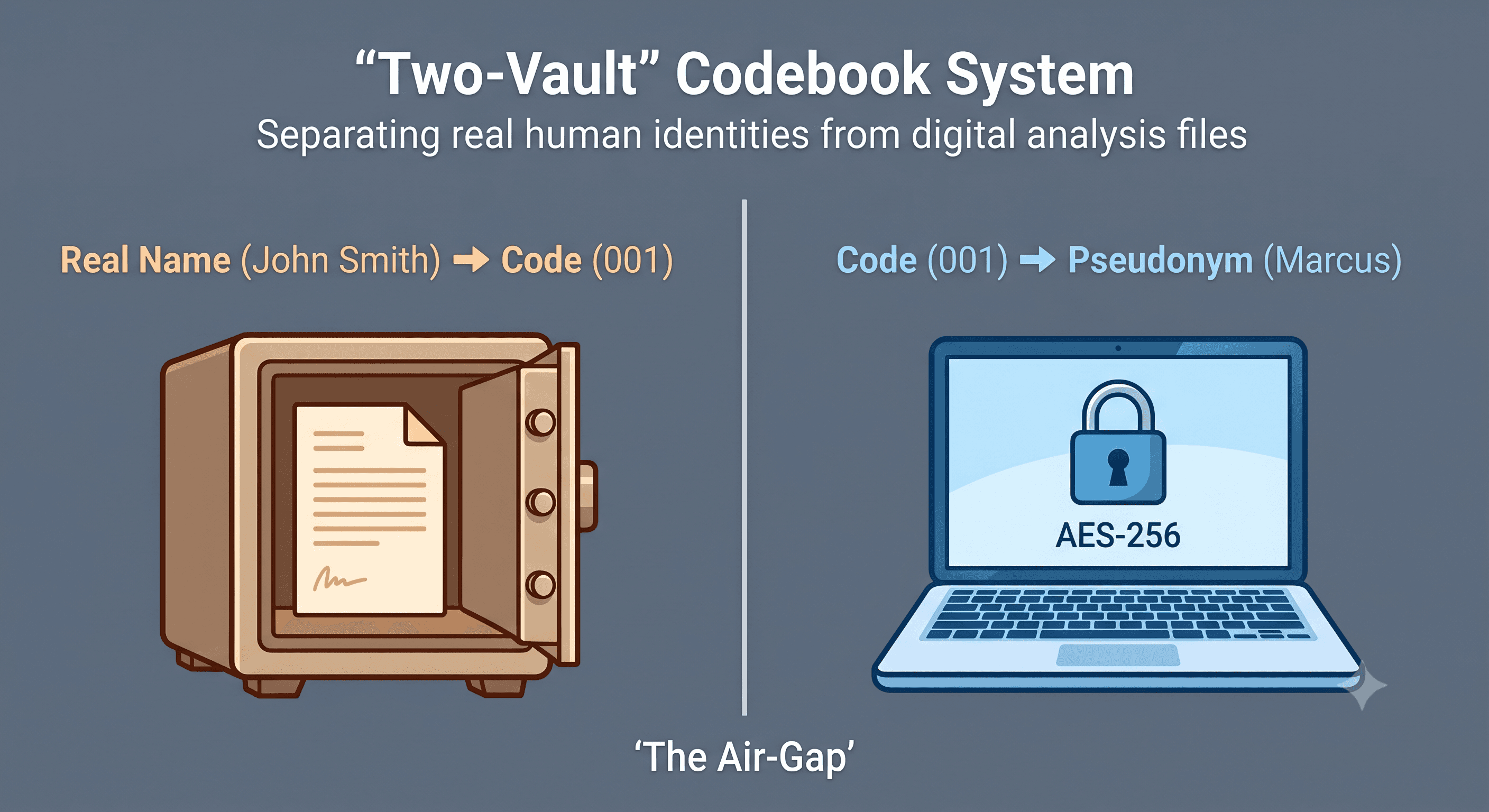
For highly sensitive studies, I write the real names and matching codes (e.g., John Smith = 001) on physical paper and lock it in a heavy physical safe (Vault 1). I have a separate digital file that links those codes to the pseudonyms used in the paper (e.g., 001 = "Marcus") (Vault 2). This air-gapped method removes real names from the digital ecosystem entirely.
Frequently Asked Questions (FAQs)
What is the difference between anonymity and confidentiality in research? Anonymity means no one, not even the researcher, knows the participant's identity (e.g., blind surveys). Confidentiality means the researcher knows the identity but is ethically and legally bound to keep it secret.
Does GDPR apply to qualitative research? Yes. If you collect qualitative data from participants in the European Union, you must comply with GDPR qualitative research rules, establishing a lawful basis for processing and preparing for data deletion requests under the Right to be Forgotten.
Are Zoom recordings safe for research interviews? Zoom is only safe if you use an enterprise, university-provided tier. You must require a meeting password, utilize a waiting room, and record locally to your encrypted hard drive, rather than relying on Zoom's cloud servers.
What are standard IRB data security requirements? Standard requirements include storing digital data on AES-256 encrypted drives, establishing a Data Succession Plan, utilizing secure university-managed servers instead of personal cloud accounts, and executing a thorough de-identification strategy before analysis.
Conclusion
When managing participant data protection, research protocols must be your absolute highest priority. The people we interview are giving us a profound gift—their time, their vulnerability, and their truth. The least we can do as ethical researchers is ensure their gift doesn't turn into a liability.
By understanding confidentiality, adhering to GDPR and HIPAA frameworks, rigorously securing the complex data lifecycle against hardware failures and software breaches, and adopting these veteran strategies, you can conduct your research with confidence.
Stay secure, and happy researching.
